The Complete Timeline of Tamil Astronomy
~3000–1500 BCE — Pre-Sangam Origins
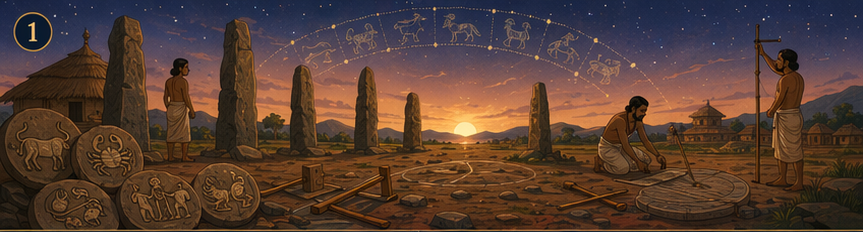
The roots of Tamil astronomical observation stretch back to the ancient Dravidian civilisation. Archaeological evidence from Indus Valley sites (3000–1500 BCE) suggests awareness of solar and stellar cycles — aligned structures, astronomical motifs on seals, and evidence of standardised measurement systems. Whether these directly connect to later Tamil astronomical tradition remains a subject of scholarly investigation.
The oldest Tamil literary references to stars appear in inscriptions and early Brahmi texts that predate the Sangam era proper.
~300 BCE – 300 CE — The Sangam Golden Age
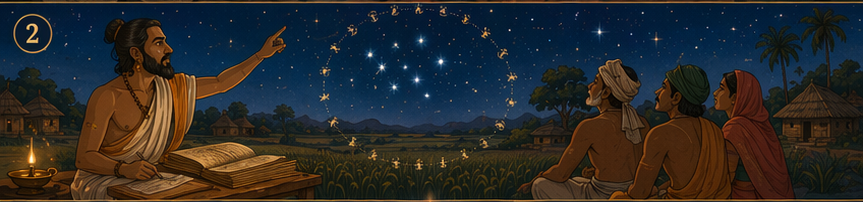
The classical Sangam period produced Tamil literature of extraordinary richness, including numerous astronomical references. The Sangam poets knew the 27 Nakshatras intimately, tracked seasonal star patterns for agricultural timing, and incorporated planetary and stellar knowledge into their poetic imagery. The Tinai system of five landscape zones encoded seasonal and astronomical awareness into literary form.
Key astronomical knowledge in Sangam texts:
- The 27 Nakshatra system fully described and in common use
- The five planets (Mars, Mercury, Jupiter, Venus, Saturn) all named
- Eclipses understood as Rahu swallowing the Sun or Moon
- Agricultural timing by star positions (heliacal risings)
- The Pleiades (Karthigai) recognised as Murugan's star cluster
~285 AD — The Zero Point
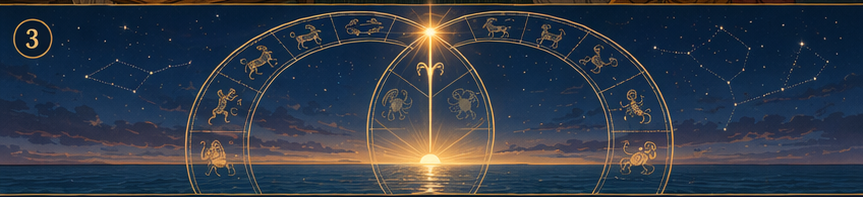
The year 285 AD marks the calculated origin point of the current Tamil calendar — the moment when the sidereal and tropical zodiacs last coincided, meaning Aries began exactly at the spring equinox. This alignment point was recognised by Tamil and broader Indian astronomers and established as the baseline from which all subsequent Ayanamsha (precession drift) is measured.
499 AD — Aryabhata's Revolution

The mathematician-astronomer Aryabhata (476–550 AD), working in the tradition that strongly influenced Tamil astronomy, published the Aryabhatiya — one of the most important scientific texts in human history. Its contributions include:
- The first explicit statement that the Earth rotates on its axis (revolutionary — contradicted the then-common view that the sky rotates around a fixed Earth)
- A highly precise calculation of Earth's circumference (within 1% of the modern value)
- Accurate values for the length of the sidereal year and lunar month
- A precise calculation of the duration of Earth's precessional cycle
- Mathematical methods for computing planetary positions that were used in Tamil Panchangam calculation for centuries
The Aryabhatiya's influence on the Tamil Drik Panchangam tradition cannot be overstated — it provided the mathematical foundation for precise Tamil astronomical calculation.
~500–700 AD — The Vakya Era
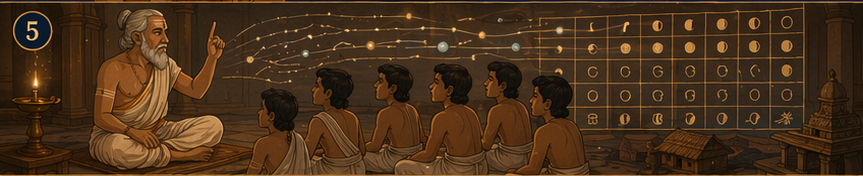
Tamil astronomers of the Pallava and early Chola period encoded Aryabhata's mathematics (and the older Surya Siddhanta) into memorable Tamil verse — creating the Vakya Panchangam tradition. These verses allowed priests and scholars to compute astronomical quantities through memorisation and arithmetic, transmitting precise sky knowledge across generations without requiring books or instruments.
This was also the period when the major Tamil Siddhanta texts were compiled and Tamil astronomy absorbed knowledge from Babylonian, Greek (through the Romaka and Paulisha Siddhantas), and earlier Indian astronomical schools.
~850–1200 AD — The Chola Golden Age
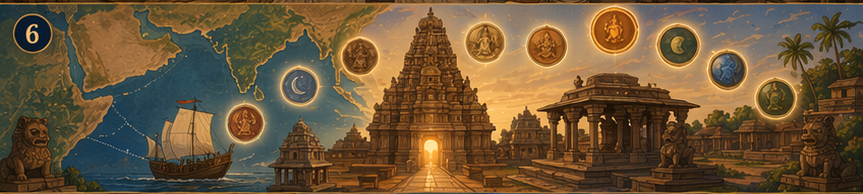
The Chola Empire, at its peak from the 9th to 13th centuries, was a major patron of Tamil astronomical scholarship. The great Chola temples — Brihadeeswara at Thanjavur, Gangaikonda Cholapuram — incorporated sophisticated astronomical alignments. The nine Navagraha temples of the Cauvery delta region were either built or extensively patronised during this period, establishing the Thanjavur region as the astronomical heartland of Tamil Nadu.
Chola administrative records show the Panchangam in active official use — astronomical calculations governed court ceremonies, military campaigns, and agricultural planning at the empire's highest levels.
~1200–1600 AD — Regional Development and Diaspora
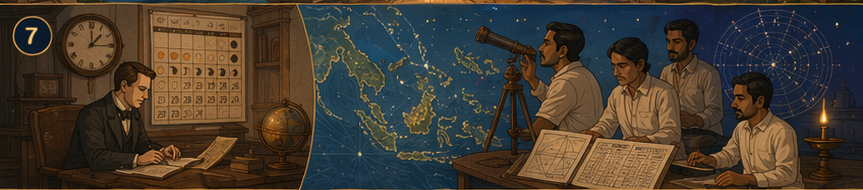
As Tamil maritime trade expanded across Southeast Asia, Tamil astronomical tradition travelled with it. Tamil calendar systems and Nakshatra-based astrology took root in Malaysia, Indonesia, Sri Lanka, and South-East Asian port cities. The Tamil calendar became the religious and agricultural timekeeper for Tamil communities across the Indian Ocean world.
During this period, the Vakya Panchangam formulas began accumulating their present-day ~1–2 day error (having been accurate when written 600–800 years earlier) — a problem that would not be formally addressed until the modern Drik system emerged.
19th–20th Century — Reform and Revival
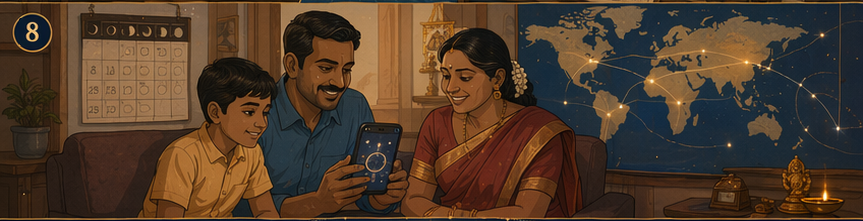
British colonial rule brought Western astronomy and the Gregorian calendar as official systems, pushing the Tamil Panchangam out of government and into purely religious use. However, the tradition never died. Tamil astronomers began developing modern Drik Panchangam methods using precise ephemeris data — reconciling the ancient Tamil lunar mansion system with modern orbital mechanics.
The Indian Government's adoption of the Indian National Calendar (Saka calendar) in 1957 used the Drik astronomical approach. Tamil Nadu's official Tamil New Year date follows Drik calculation.
Today — A Living 2,000-Year Tradition
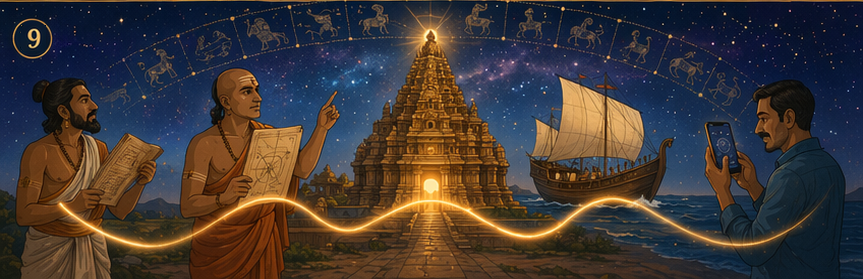
The Tamil Panchangam is published annually by dozens of organisations. Millions of Tamil families worldwide check the Nakshatra, Tithi, and auspicious times daily. Tamil astrology apps have millions of users. The 27-Nakshatra system, the 9-Graha model, and the 60-year Jovian cycle — all developed by Tamil astronomers over two millennia — remain in active, daily use, making Tamil astronomy one of the longest continuously practised scientific traditions on Earth.
Tamil astronomy is not a museum piece — it is a living tradition. On any given day in Tamil Nadu, Malaysia, Singapore, Sri Lanka, and Tamil diaspora communities worldwide, hundreds of thousands of people are consulting a Panchangam that traces its mathematical roots directly back to Aryabhata (499 AD) and the Sangam era astronomers (300 BCE–300 CE). The stars they watch are the same; the tradition connecting them to those stars is unbroken.