Who Was Aryabhata?
Aryabhata (ஆர்யபட்ட) was born in 476 AD, most likely in the region of present-day Bihar, and studied at the great university of Nalanda. At the astonishing age of 23, he completed his masterwork — the Aryabhatiya — a compact 118-verse text that revolutionised Indian and Tamil astronomy forever.
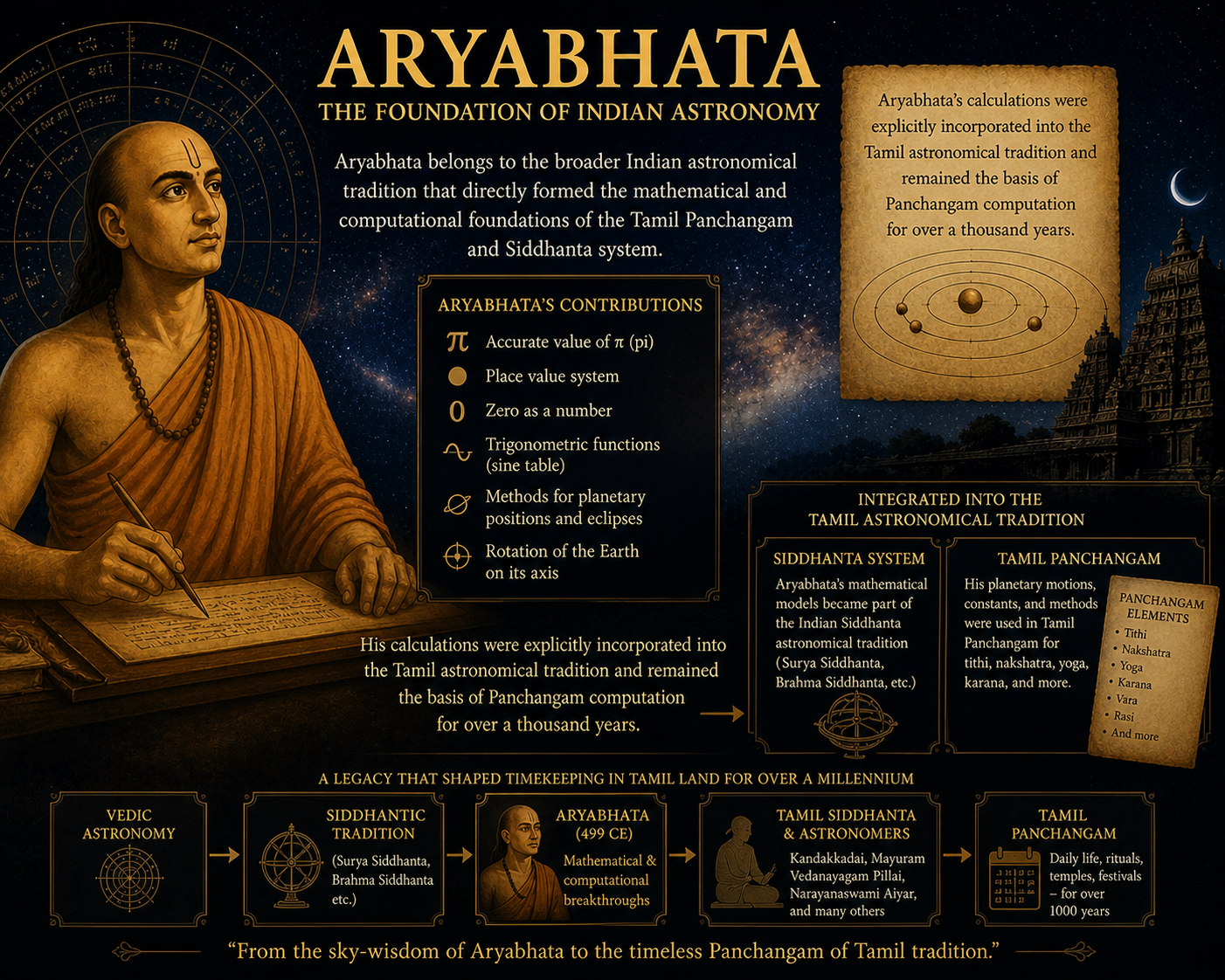
Aryabhata belongs to the broader Indian astronomical tradition that directly formed the mathematical and computational foundations of the Tamil Panchangam and Siddhanta system. His calculations were explicitly incorporated into the Tamil astronomical tradition and remained the basis of Panchangam computation for over a thousand years.
The Earth Rotates — Aryabhata's Most Radical Claim
Aryabhata's single most revolutionary scientific statement was his declaration that the Earth rotates on its own axis — causing the apparent motion of the stars. He wrote (Aryabhatiya, Golapada 9): the rising and setting of stars is caused by the rotation of the Earth, not the movement of the sky.
This directly contradicted the prevailing geocentric view that the entire sky — stars, Sun, Moon, and planets — rotated around a fixed, stationary Earth. Aryabhata's heliocentric-leaning insight predated Copernicus by over a thousand years. His position was controversial; later Indian astronomers like Brahmagupta actually criticised him for this claim. History has vindicated Aryabhata completely.

His Astronomical Achievements
| Achievement | Aryabhata's Value | Modern Value | Accuracy |
|---|---|---|---|
| Sidereal day (Earth's rotation) | 23h 56m 4.1s | 23h 56m 4.091s | Within 0.001 seconds |
| Sidereal year | 365d 6h 12m 30s | 365d 6h 9m 10s | Within 3 minutes |
| Earth's circumference | 39,968 km | 40,075 km | Within 1% |
| Moon's diameter | 3,300 km (approx.) | 3,474 km | Within 5% |
| Distance to Moon | 384,000 km (approx.) | 384,400 km | Within 0.1% |
| Pi (π) | 3.1416 (62832/20000) | 3.14159… | Correct to 4 decimal places |
The Aryabhatiya and Tamil Astronomy
The Aryabhatiya arrived at a pivotal moment — 285 AD had been recognised as the origin point of the Tamil calendar, and the 214-year gap to 499 AD had introduced the first measurable Ayanamsha (precession drift). Aryabhata's precise calculations gave Tamil astronomers the mathematical tools to:
- Calculate the Ayanamsha with precision for any given year
- Compute the Sun's entry into Aries (Mesha Sankranti / Tamil New Year) accurately to within hours
- Predict lunar and solar eclipses with high precision
- Calculate the positions of all five visible planets for any date
- Establish a mathematically rigorous foundation for the Panchangam
The modern Drik Panchangam is the direct computational heir of Aryabhata's methods — updated with modern ephemeris data but following the same mathematical framework he established in 499 AD.
Aryabhata and the Value of Zero
While the explicit development of zero as a number is often credited to Brahmagupta (628 AD), Aryabhata's positional number system implicitly required a placeholder for zero. His astronomical calculations — involving large numbers for planetary orbital periods — necessitated a sophisticated numerical framework. Aryabhata used a letter-based number system that encoded large quantities in compact verse, demonstrating fluency with the concept of positional value that later crystallised into the decimal zero.
His Legacy in Tamil Culture
India's first satellite, launched in 1975, was named Aryabhata in his honour. The Indian Space Research Organisation (ISRO), which has launched Tamil-related Earth observation missions, traces its scientific lineage back through this same tradition. When ISRO scientists calculate orbital mechanics today, they use the same mathematical principles — planetary motion, circular orbit computation, celestial coordinate systems — that Aryabhata formalised in 499 AD on the banks of the Ganges.
Aryabhata at 23 knew things that Europe would not accept for another 1,000 years. That the Earth rotates. That it is a sphere. Its approximate size. The cause of eclipses. The length of the year to within minutes. He wrote it all in 118 compact verses, in the same intellectual tradition that produced the Tamil Panchangam, the 27-Nakshatra system, and the Thirukkural. Ancient India was not a land of myths and mysticism alone — it was home to one of the greatest scientific traditions in human history.