The Three Tamil
Sangams
Three cosmic councils spanning ~10,000 years — presided by Sivan, Murugan, and Perumal — guardians of the oldest literary tradition on Earth.
சிவன்
முருகன்
கிருஷ்ணன்
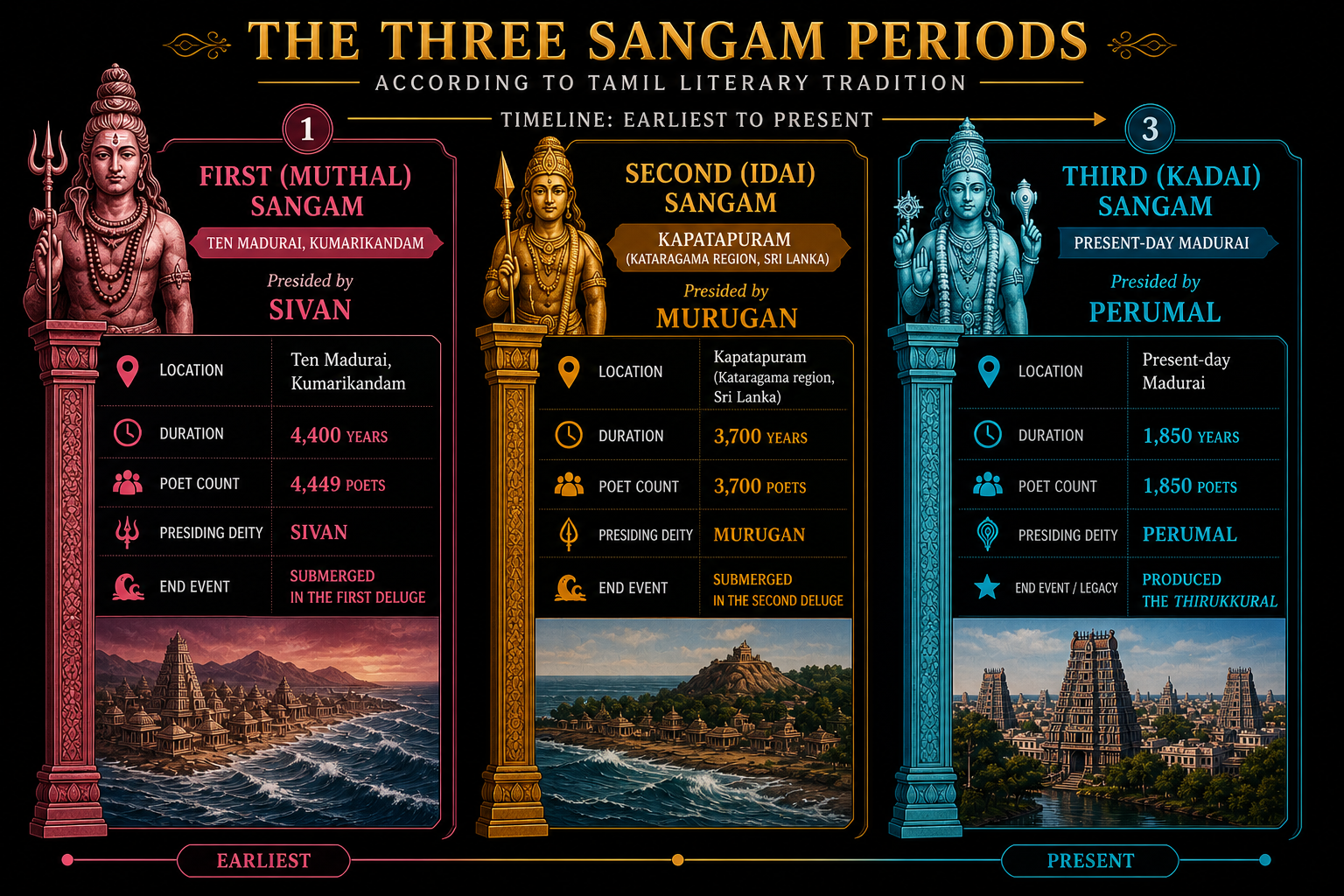
What Were the Tamil Sangams?தமிழ் சங்கங்கள் என்றால் என்ன?
The word Sangam (சங்கம்) means "assembly" or "gathering" — specifically, an academy of poets and scholars convened under royal and divine patronage. Tamil tradition records three successive Sangams, each one the cultural and literary heartbeat of its age.
Unlike ordinary literary academies, the Tamil Sangams are said to have been divinely presided — each under the patronage of one of the three great Tamil deities: சிவன் (Sivan), முருகன் (Murugan), and திருமால் / பெருமாள் (Perumal). This divine threefold structure mirrors the three stars of Orion's Belt — a connection noted in the cosmic study of Thirukkural and the Cosmos.
The three Sangam deities map precisely onto the three stars of Orion's Belt: Alnilam → Sivan, Mintaka → Murugan, Alnitak → Krishna/Perumal. The same cosmic tripling appears in the Giza pyramid alignment — suggesting an ancient, shared astronomical memory.
ஓரியன் நட்சத்திர மண்டலத்தின் மூன்று நட்சத்திரங்கள் — சிவன், முருகன், கிருஷ்ணன் — மூன்று சங்கங்களின் அடிப்படை.
The Three Sangams — Timelineமூன்று சங்கங்களின் காலவரிசை
Each Sangam marked a distinct epoch — different continent, different city, different divine guardian — yet all three formed an unbroken river of Tamil literary genius.
Muthal Sangam
The first and most ancient of the three assemblies was established in Ten Madurai (தென்மதுரை — Southern Madurai), the capital of Kumarikandam (குமரிக்கண்டம்) — the great southern land that now lies beneath the Indian Ocean, south of present-day Sri Lanka. Tamil tradition records that this legendary continent was the original homeland of the Tamil people.
Sivan himself is said to have presided over this first assembly of poets. The great sage Agastya Muni (அகத்தியர்) is credited with compiling the first formal grammar of Tamil — Agattiyam — during this period. The Sangam ended when Kumarikandam was swallowed by the sea in a great deluge.
Idai Sangam
Survivors of the first deluge moved northward and established a new capital at Kapatapuram (கபாடபுரம்), also known as Kavata or South Madurai. This city occupied the region that included the southern part of present-day Sri Lanka, including the area of Kathirkamam (Kataragama) (கதிர்காமம்) — the sacred hill abode of Murugan that remains a pilgrimage site to this day.
Murugan — god of youth, war, wisdom and the hills — presided over this second Sangam. The second great Tamil grammar text, Agattiyam's continuation, and the earliest forms of classical Tamil poetry are attributed to this era. The second city also eventually sank beneath the sea.
Kadai Sangam
The third and final Sangam was established in the city of Madurai (மதுரை) — the same great city that stands in Tamil Nadu today. Under the patronage of Perumal (Thirumal / Vishnu), this assembly produced the literary masterworks that survive into the present day.
This is the Sangam age whose poetry we can still read: the Purananuru, Akananuru, Ettuttokai, Pattupattu collections — and most importantly, the Thirukkural (திருக்குறள்) by Thiruvalluvar, whose 1,330 couplets encode both human wisdom and astronomical precision. The third Sangam is the one attested by surviving texts and is accepted by modern scholarship.
Sacred Locationsபுனித இடங்கள்
Each Sangam was rooted in a specific geography — two now lost beneath the sea, one still alive today.
Kumarikandam
The legendary southern continent, believed to have extended south of present-day India and Sri Lanka, now submerged beneath the Indian Ocean. Modern geologists confirm sea-level rise of 100–120m since the last Ice Age (~10,000 BCE), supporting the possibility of submerged coastal civilisations. Capital city: Ten Madurai (Southern Madurai).
Kapatapuram & Kathirkamam
The second Sangam city, Kapatapuram, occupied the southern Sri Lanka coastal region. Kathirkamam (Kataragama) in southeastern Sri Lanka remains the holiest living shrine of Murugan — a direct cultural memory linking the second Sangam to that sacred hill. Still venerated by Tamils, Sinhalese, and Vedda people alike.
Madurai — The Eternal City
Present-day Madurai, Tamil Nadu — one of the oldest continuously inhabited cities on Earth. The Meenakshi Amman Temple complex stands at its centre, dedicated to Goddess Meenakshi (Parvati) and Sundareswarar (Sivan) — a living temple-observatory that encodes the same astronomical alignments as described in Tamil astronomical tradition.
The Orion–Sangam Connectionஓரியன் — சங்கம் தொடர்பு
The research in Thirukkural and the Cosmos reveals that the three Tamil deities who presided over the Sangams correspond directly to the three stars of Orion's Belt — the same stellar alignment that governed the layout of the Giza pyramids circa 10,500 BCE.
According to the Orion Correlation Theory (Robert Bauval, 1994), the Giza pyramids mirror Orion's Belt as it appeared at ~10,500 BCE — placing the first cosmic alignment at precisely the period when Tamil tradition places the First Sangam in Kumarikandam. Whether coincidence or shared prehistoric knowledge, the numerical and astronomical parallels remain remarkable.
கி.மு. 10,500-ல் ஓரியன் நட்சத்திர அமைப்பு கிஸா பிரமிட்களிலும், தமிழ் முதல் சங்கத்திலும் ஒரே நேரத்தில் பதிவாகியுள்ளது.
Master Referenceமுழு அட்டவணை
| Sangam · சங்கம் | Deity · கடவுள் | Location · இடம் | Duration | Poets | Key Work |
|---|---|---|---|---|---|
| First (Muthal) முதல் சங்கம் |
Sivan சிவன் |
Ten Madurai, Kumarikandam குமரிக்கண்டம் |
4,400 yrs ~9990–5590 BCE |
549 | Agattiyam அகத்தியம் |
| Second (Idai) இடைச் சங்கம் |
Murugan முருகன் |
Kapatapuram கபாடபுரம் |
3,700 yrs ~5590–1890 BCE |
59 | Early classical Tamil poetry |
| Third (Kadai) கடைச் சங்கம் |
Perumal (Thirumal) பெருமாள் / திருமால் |
Madurai, Tamil Nadu மதுரை |
1,850 yrs ~1890 BCE–300 CE |
449 | Thirukkural திருக்குறள் |
A Note on Sourcesஆதாரங்கள் பற்றி
The accounts of the First and Second Sangams come from Tamil classical literature, principally from commentaries such as Iraiyanar Akapporul and the Silappatikaram. The Third Sangam is attested by surviving literary works and is broadly accepted by scholars.
The First and Second Sangams are accounts from Tamil literary tradition — not yet confirmed by modern archaeology. However, the science of post-glacial sea-level rise strongly supports the possibility of submerged civilisations in the Indian Ocean region. The dates given here follow traditional Tamil reckoning. Modern scholarly estimates for the Third Sangam place it between approximately 300 BCE and 300 CE.
முதல் இரு சங்கங்களின் கதைகள் தமிழ் இலக்கிய மரபிலிருந்து வருகின்றன. மூன்றாம் சங்கம் மட்டுமே நவீன ஆராய்ச்சியால் உறுதிப்படுத்தப்பட்டுள்ளது.