
The Nine Grahas (Planets)
Tamil astronomy recognises nine Grahas (கிரகங்கள் — "seizers" or "influencers") — seven visible planets plus two mathematical points called shadow planets. The word Graha does not mean "planet" in the modern astronomical sense — it means an object that "grasps" or influences time and events. The nine Grahas between them rule all 27 Nakshatras, all 7 weekdays, and all horoscopic positions.
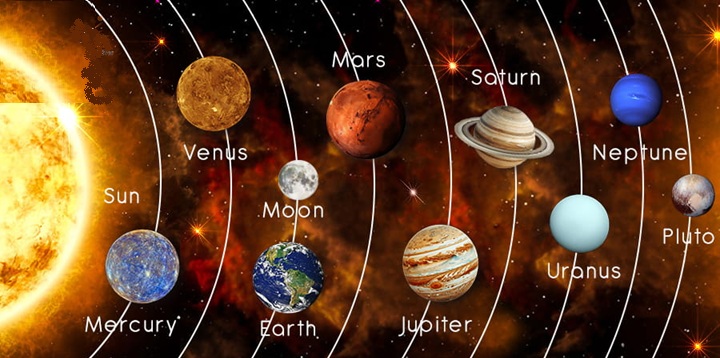
| Graha | Tamil Name | Western | Tamil Script | Weekday | Rules Nakshatras | Qualities |
|---|---|---|---|---|---|---|
| Suryan | Suryan / Adityan | Sun | சூரியன் | Sunday (Nyayiru) | Karthigai, Uthiram, Uthiradam | Soul, father, authority, vitality, dharma |
| Chandran | Chandran / Thingal | Moon | சந்திரன் | Monday (Thingal) | Rohini, Hastham, Thiruvonam | Mind, mother, emotions, cycles, water |
| Chevvai | Chevvai / Angarakan | Mars | செவ்வாய் | Tuesday (Sevvai) | Mrigashira, Chithirai, Avittam | Energy, courage, conflict, blood, brothers |
| Budhan | Budhan | Mercury | புதன் | Wednesday (Budhan) | Ayilyam, Kettai, Revathi | Intellect, communication, trade, analysis |
| Guru | Guru / Brihaspati | Jupiter | குரு / வியாழன் | Thursday (Viyazhan) | Punarvasu, Vishakam, Poorattathi | Wisdom, expansion, dharma, teacher, children |
| Shukran | Shukran / Velli | Venus | சுக்கிரன் | Friday (Velli) | Bharani, Pooram, Pooradam | Love, beauty, arts, luxury, marriage, wealth |
| Sani | Sani / Shaniswaran | Saturn | சனி | Saturday (Sani) | Poosam, Anusham, Uthirattathi | Karma, discipline, delay, endurance, justice |
| Rahu | Rahu / Serulan | North Lunar Node | ராகு | No dedicated day | Thiruvathirai, Swathi, Sadhayam | Illusion, ambition, obsession, foreign, sudden |
| Ketu | Ketu / Pushan | South Lunar Node | கேது | No dedicated day | Ashwini, Magam, Moolam | Liberation, spirituality, research, detachment |
Rahu and Ketu — The Shadow Planets
Rahu and Ketu are not physical planets — they are the two points where the Moon's orbit crosses the Sun's apparent path (the ecliptic). These crossing points are called lunar nodes. When the Moon is at or near a node and the Sun is also nearby, an eclipse occurs — which is why Rahu and Ketu are specifically and precisely the eclipse planets in Tamil astronomy.
The nodes are always exactly 180° apart and move slowly backwards through the zodiac (retrograde), completing one full cycle in approximately 18.6 years. Rahu is the north node (ascending) and Ketu is the south node (descending). See our dedicated article: Rahu, Ketu & Eclipse Science.
The Seven Sacred Navagraha Temples of Tamil Nadu
Tamil Nadu contains a unique circuit of nine Navagraha temples, each dedicated to one of the nine Grahas, mostly clustered around the Cauvery delta in the Thanjavur region — one of the richest astronomical heritage zones in India:
| Graha | Temple Name | Location | Presiding Deity |
|---|---|---|---|
| Sun | Suryanar Koil | Kumbakonam | Suriyanar |
| Moon | Thingalur | Near Papanasam | Kailasanathar |
| Mars | Vaitheeswaran Koil | Sirkazhi | Vaitheeswaran (healing Shiva) |
| Mercury | Thiruvenkadu | Sirkazhi district | Swetharanyeswarar |
| Jupiter | Alangudi | Near Kumbakonam | Apatsahayeswarar |
| Venus | Kanjanur | Near Kumbakonam | Agneeswarar |
| Saturn | Thirunallar | Near Karaikal | Darbaranyeswarar |
| Rahu | Thirunageswaram | Near Kumbakonam | Naganathaswami |
| Ketu | Keezhperumpallam | Near Sirkazhi | Naganathaswami |
Guru Peyarchi — Jupiter's Annual Transit
Of all planetary movements, Guru Peyarchi (Jupiter's transit to a new Rasi) is the most watched event in Tamil astrology. Jupiter spends approximately one year in each zodiac sign, taking ~12 years to complete all 12. The day Jupiter changes Rasi is a major astrological event — Tamil families visit temples, astrologers issue predictions for all 12 Rasis, and special pujas are performed.
Jupiter's transit directly affects different Rasi signs differently — some signs experience a beneficial Guru period while others face the challenging Ashtama Guru or Ezhara Sani (Saturn's 7.5-year cycle). These two major planetary transits — Jupiter's annual shift and Saturn's 2.5-year shift — are the rhythmic heartbeats of Tamil astrological time.
Sani Dasha — Saturn's 19-Year Period
In the Tamil astrological Dasha (planetary period) system, each of the 9 Grahas rules a specific number of years in a person's life cycle. Saturn's Dasha lasts 19 years — the longest of any planet. This is why Saturn carries such weight in Tamil astrological tradition: a person born in Saturn's Dasha period will spend nearly two decades under its influence of discipline, patience, karmic accountability, and endurance.
The cumulative Dasha cycle runs 120 years (Ketu 7 + Venus 20 + Sun 6 + Moon 10 + Mars 7 + Rahu 18 + Jupiter 16 + Saturn 19 + Mercury 17 = 120), cycling from a starting point determined by the Moon's Nakshatra at birth.
The Navagraha are not mere mythology — they are a functional astronomical model. The seven planets (Sun through Saturn) are the seven naked-eye wanderers visible to anyone who watches the night sky carefully. Rahu and Ketu are the precise mathematical points that predict eclipses. The entire system is a practical tool for tracking celestial events and their correlations with earthly time cycles, developed over more than 2,000 years of careful observation.