Motion 1 — Rotation (Daily Spin)
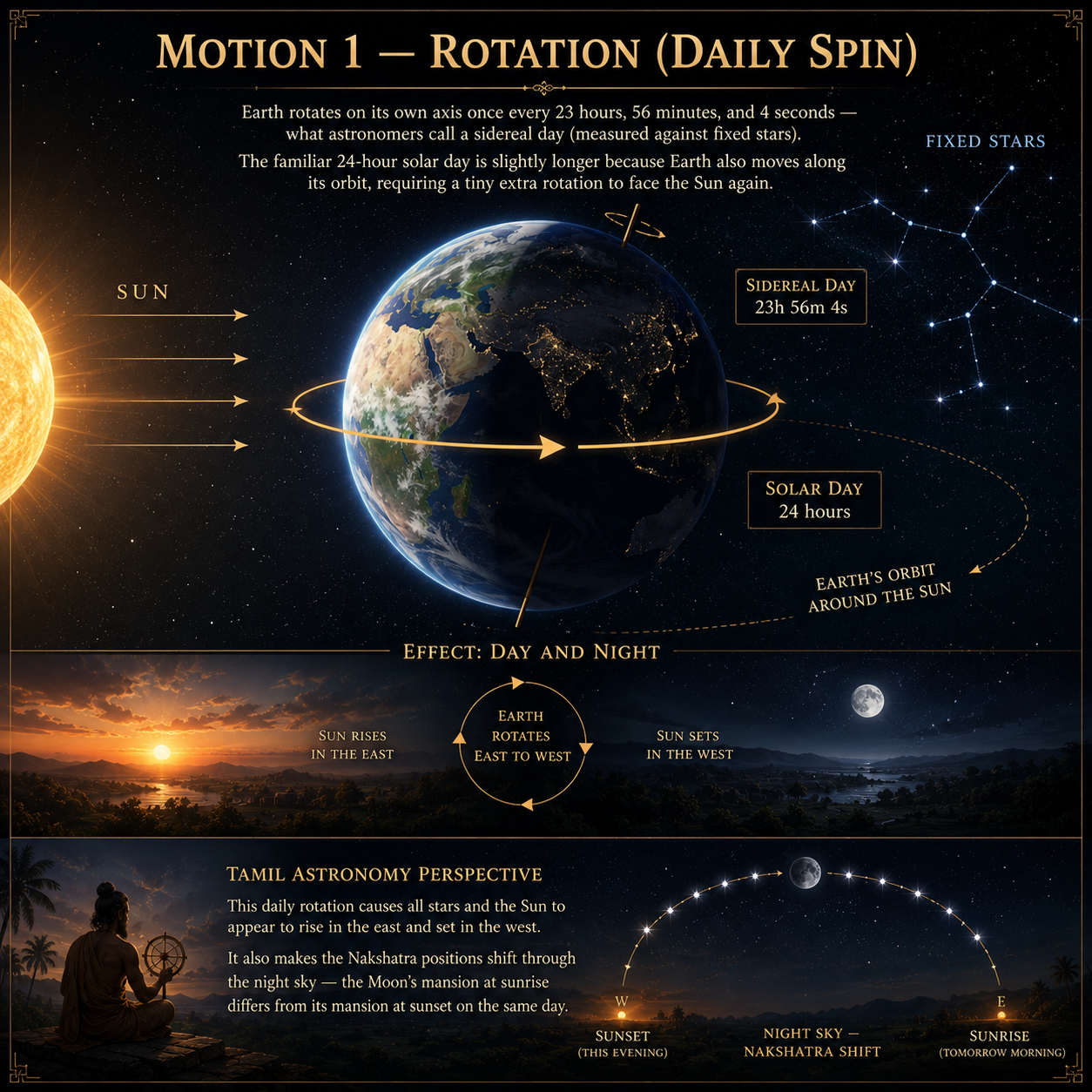
Earth rotates on its own axis once every 23 hours, 56 minutes, and 4 seconds — what astronomers call a sidereal day (measured against fixed stars). The familiar 24-hour solar day is slightly longer because Earth also moves along its orbit, requiring a tiny extra rotation to face the Sun again.
This daily rotation creates the rhythm of day and night, and causes all stars and the Sun to appear to rise in the east and set in the west. From a Tamil astronomy perspective, this rotation is what makes the Nakshatra positions shift through the night sky — the Moon's mansion at sunrise differs from its mansion at sunset on the same day.
Motion 2 — Orbit (The Annual Journey)
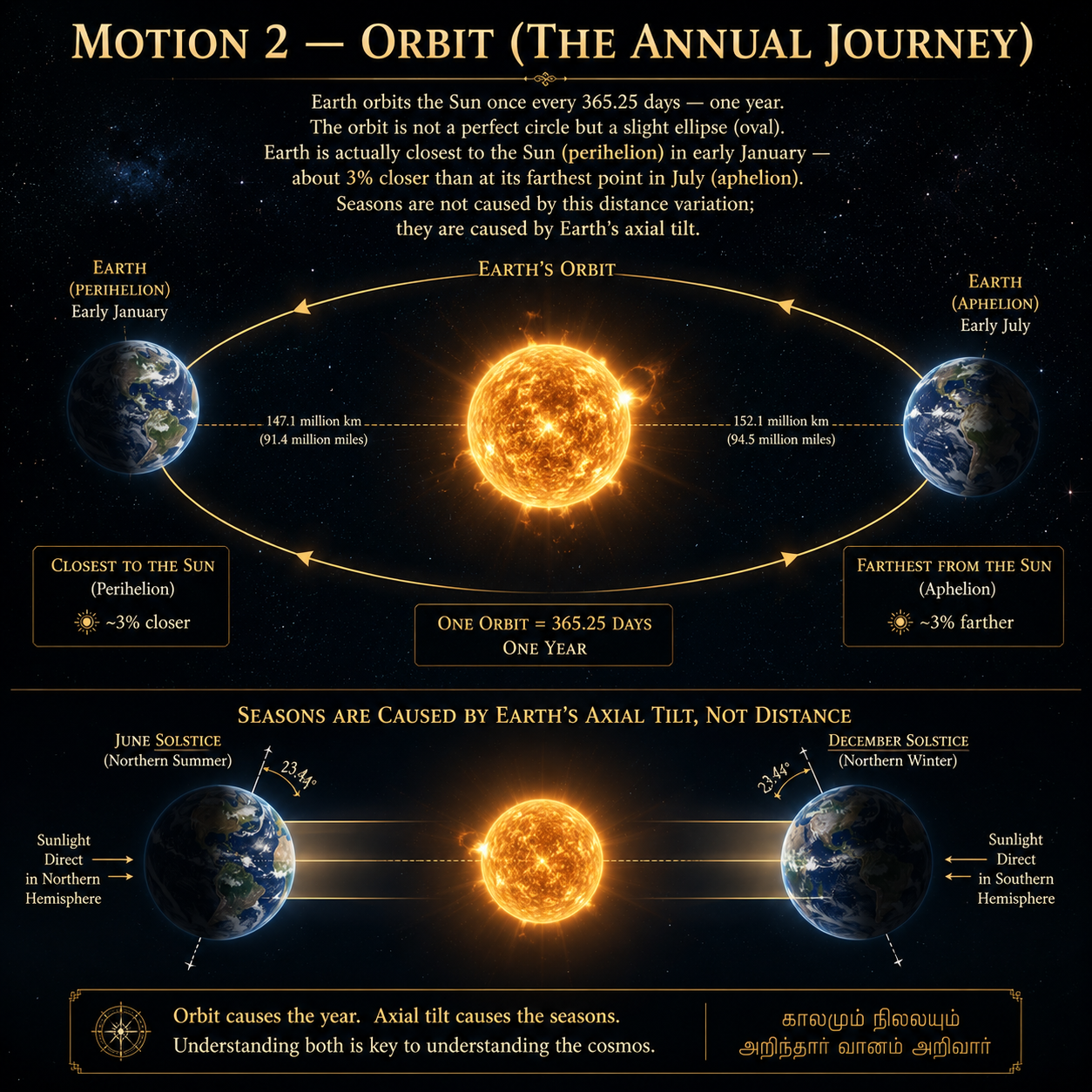
Earth orbits the Sun once every 365.25 days — one year. The orbit is not a perfect circle but a slight ellipse (oval). Earth is actually closest to the Sun (perihelion) in early January — about 3% closer than at its farthest point in July (aphelion). Seasons are not caused by this distance variation; they are caused by Earth's axial tilt.
There are two ways to measure this orbit, and this distinction is at the heart of the Tamil calendar debate:
- Tropical year (365.2422 days): From one vernal equinox to the next. This measures seasons — the time for temperatures to complete one hot-cold cycle.
- Sidereal year (365.2564 days): From one position relative to fixed stars to the same position again. This measures Earth's journey against the background constellations.
The Tamil calendar uses the sidereal year. The Gregorian calendar uses the tropical year. This 20-minute annual difference is why Tamil New Year has drifted 24 days from the equinox over 1,741 years.
Motion 3 — Precession (The Great Wobble)
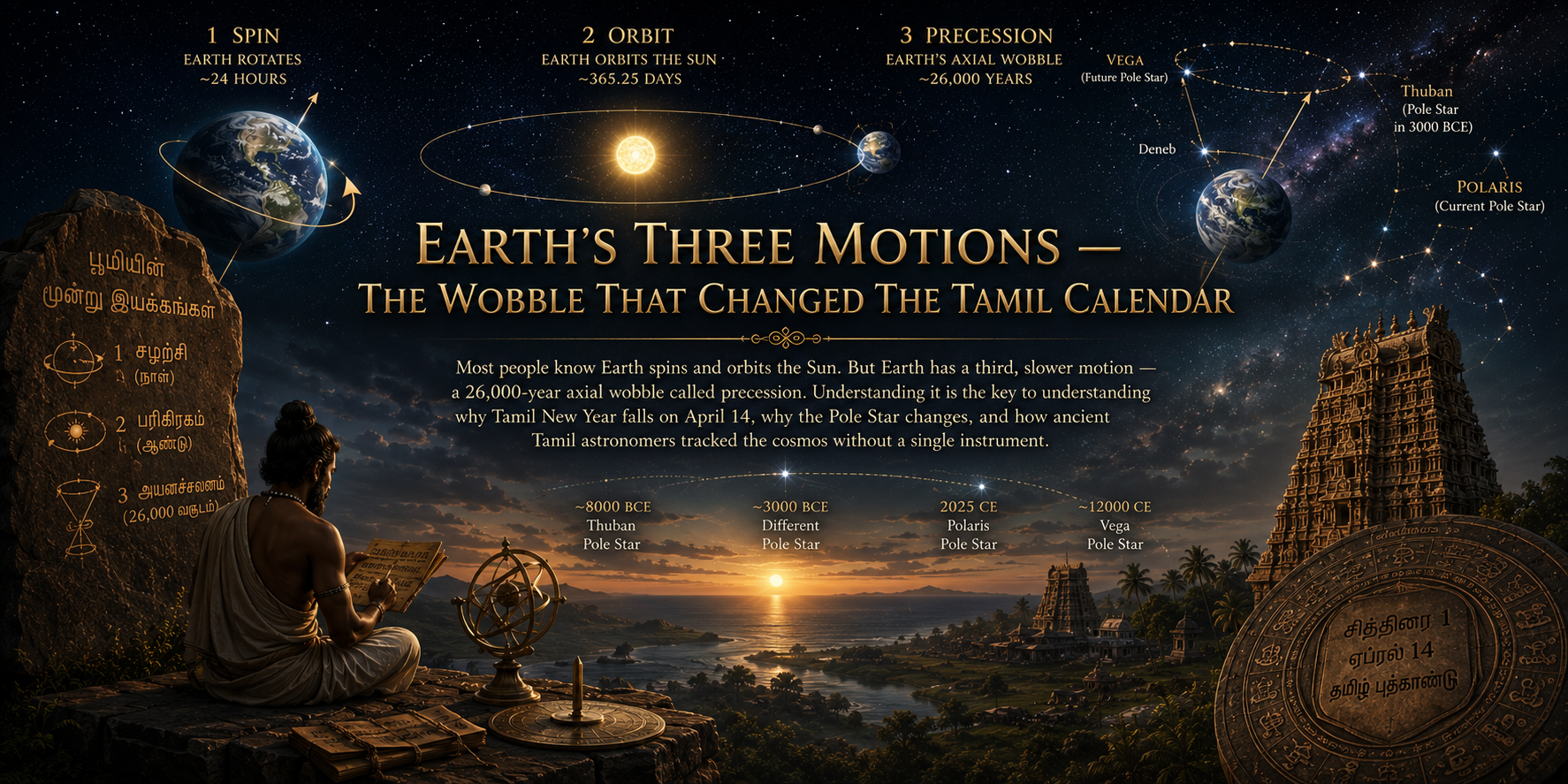
This is the most dramatic and least known of Earth's three motions. Earth's axis is tilted at 23.5° to its orbital plane — this tilt is what creates our seasons. But that axis is not fixed. It wobbles, slowly tracing a cone shape in space, like a spinning top that is gradually slowing down.
One complete wobble takes approximately 25,772 years. This is called the precession of the equinoxes, or simply precession. It is driven by the gravitational pull of the Moon and Sun on Earth's equatorial bulge — our planet is not a perfect sphere, it is slightly fatter at the equator, giving gravity something to "grip."
The Changing Pole Star
The most visible effect of precession is that our North Star changes over time:
| Era | North Star | Notes |
|---|---|---|
| ~3000 BCE | Thuban (Alpha Draconis) | The pole star when the Egyptian pyramids were built |
| ~2800 BCE | Thuban | The pyramid shafts at Giza aligned to Thuban, not Polaris |
| Today (2026) | Polaris (Alpha Ursae Minoris) | Currently within ~0.7° of the celestial north pole |
| ~14,000 AD | Vega (Alpha Lyrae) | Six times brighter than Polaris — the future North Star |
| ~27,800 AD | Polaris again | One full precessional cycle complete |
Precession and the Tamil Calendar
In Tamil astronomy, precession manifests as Ayanamsha — the growing angular gap between tropical and sidereal zodiacs. At roughly ~50 arc-seconds per year (about 1 degree in 72 years), this gap has grown to around 24 degrees in current epochs, producing an approximately 24-day separation from equinox-based dates.
How ancient Tamils detected precession without instruments: By keeping meticulous records of which star rose on the eastern horizon at sunrise on the same calendar date across many generations, scholars could detect the slow drift. At 1 degree per 72 years, the change is invisible within a single lifetime but unmistakable across 200–300 years of careful records.
Why Earth Wobbles — The Physics
Earth is not a perfect sphere. It bulges at the equator — equatorial diameter is ~43 km larger than polar diameter. The Moon and Sun's gravity pulls on this bulge unevenly (more strongly on the near side than the far side), creating a torque — a twisting force — on Earth's axis. Instead of pulling the axis upright, this torque causes the axis to precess, slowly rotating around a central point.
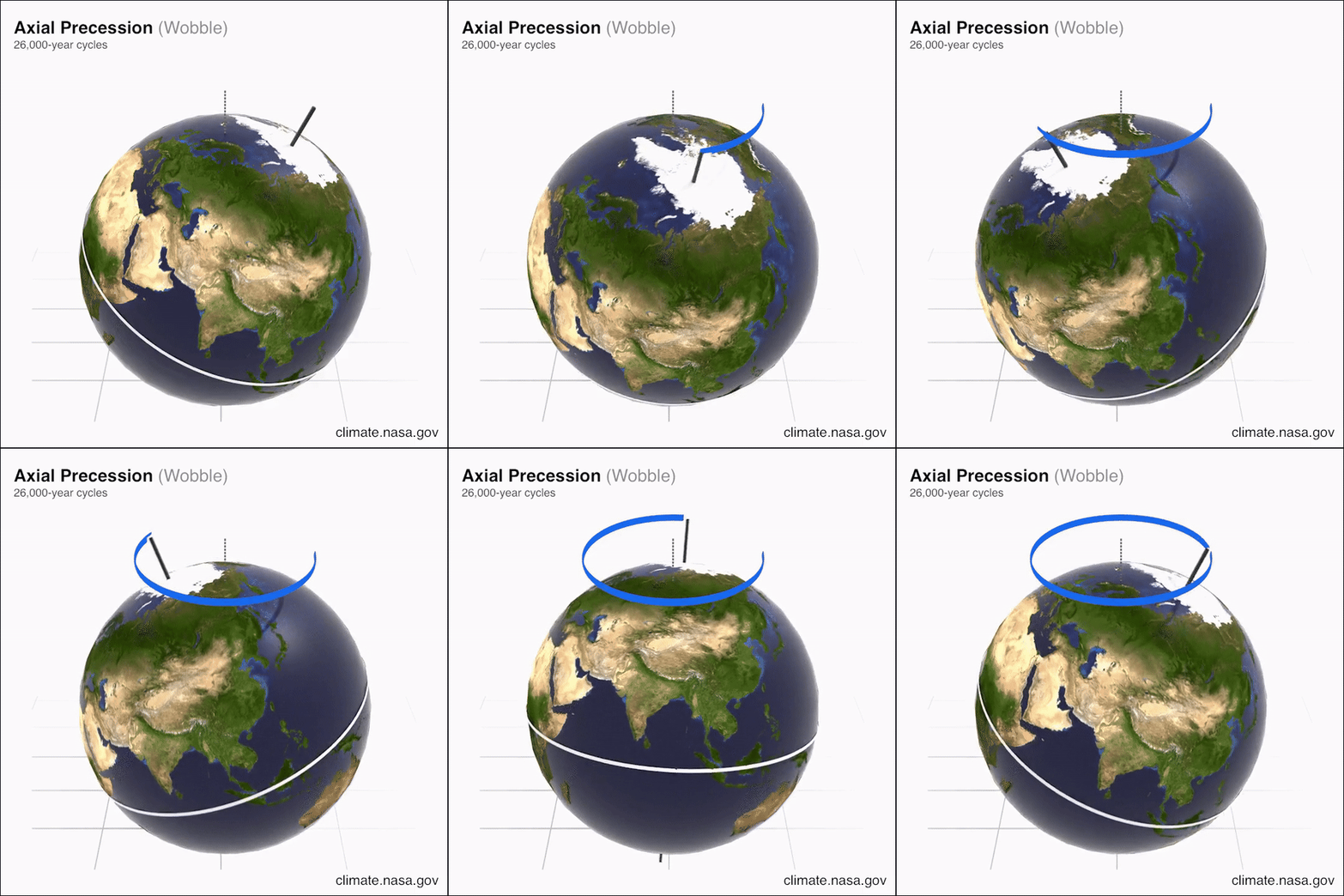
The same physics governs a spinning gyroscope. Push sideways on a spinning gyroscope and it does not simply fall — it precesses, with its axis slowly circling. Earth is a large natural example of this behavior.
Other Long-Period Motions
Beyond precession, Earth has additional long-period motions that affect climate over very long timescales:
- Axial tilt variation: Earth's 23.5° tilt itself slowly oscillates between 22.1° and 24.5° over a cycle of ~41,000 years.
- Orbital eccentricity: The elliptical shape of Earth's orbit slowly becomes more or less circular over ~100,000 and ~400,000 year cycles.
- Precession of the orbit: The direction of the ellipse itself slowly rotates over ~112,000 years.
These three cycles together — known as Milankovitch cycles — drive the long-term rhythm of ice ages on Earth. The 26,000-year precession cycle is the fastest of these three, and the one most directly noticed by ancient astronomers watching the night sky across generations.